Memories Relived
Yuhang Qiu
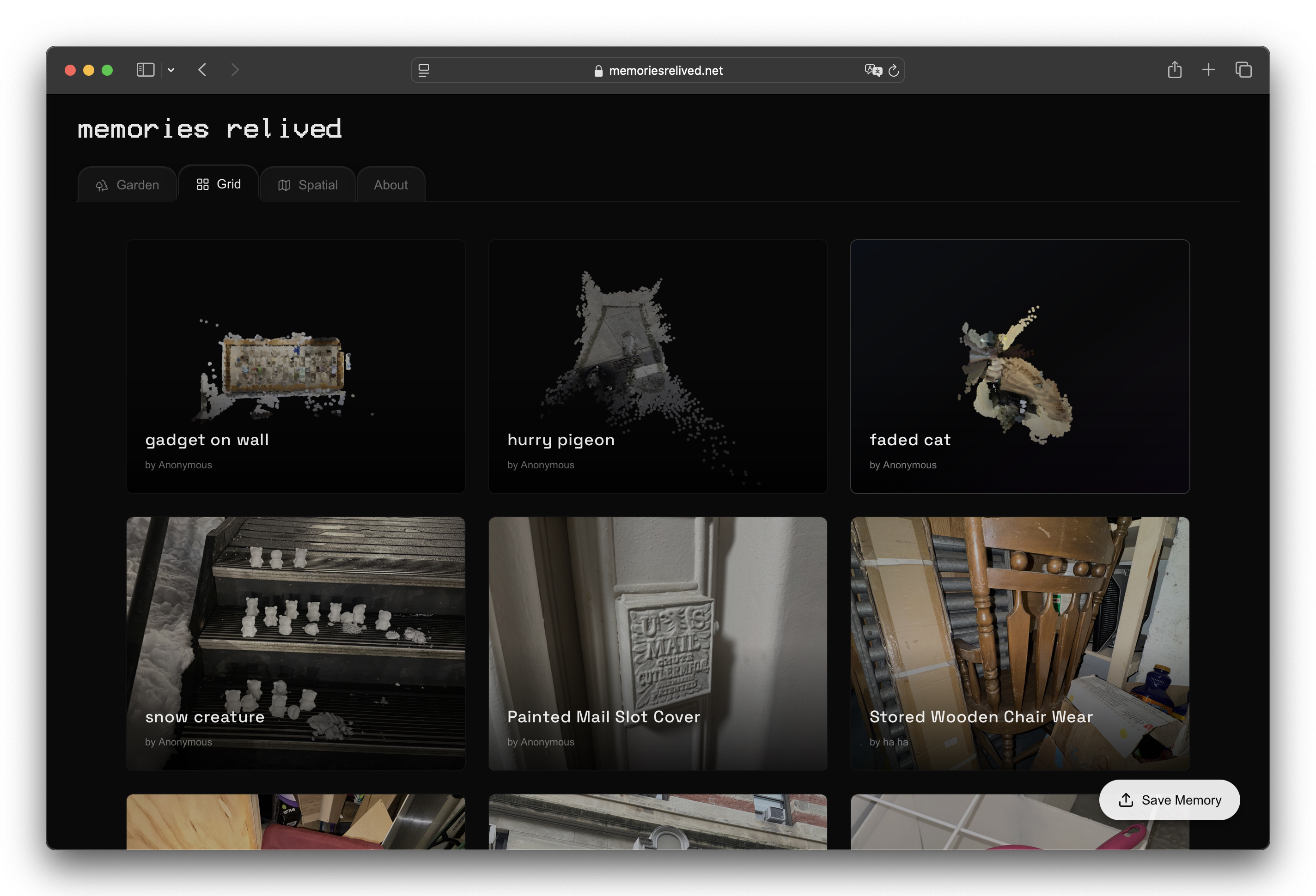
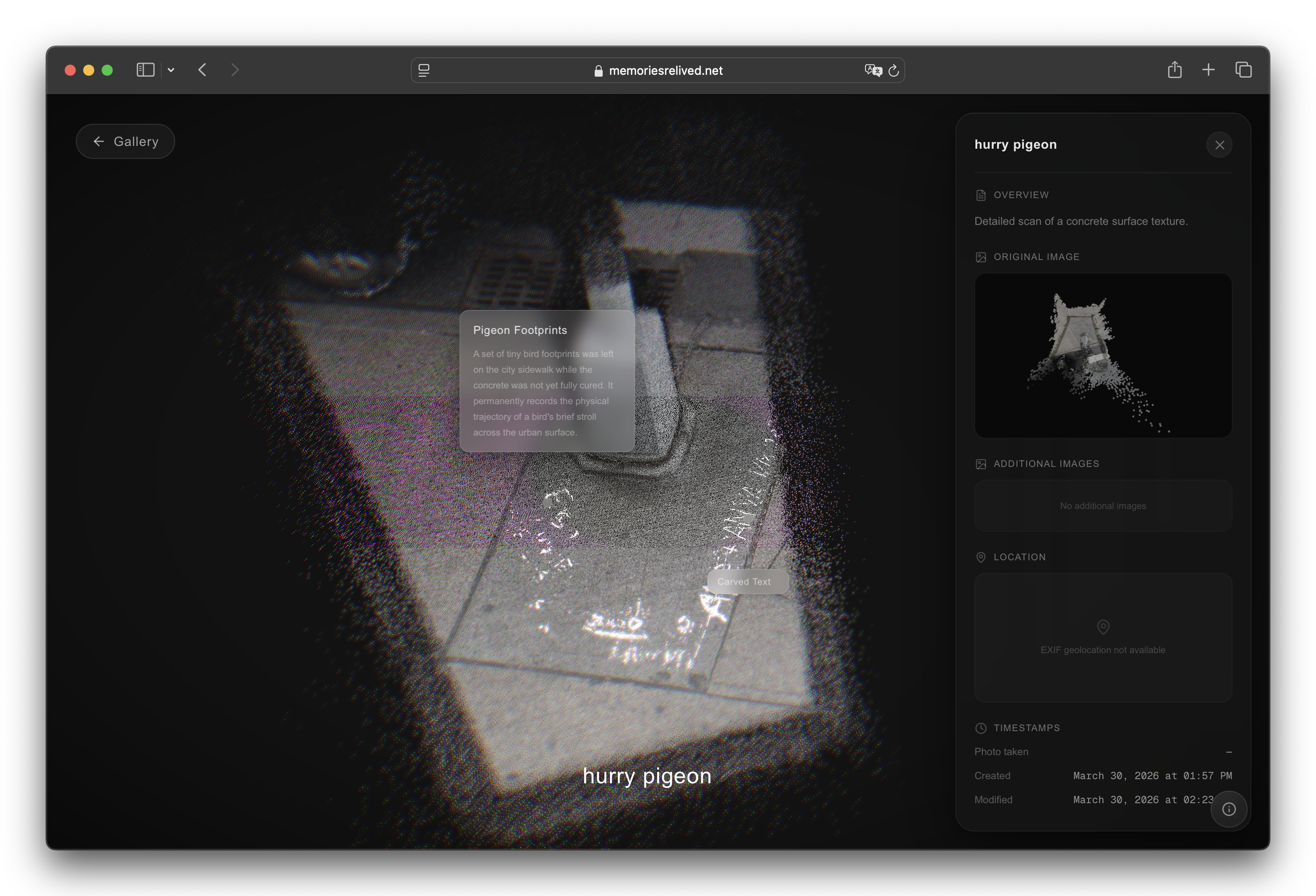
Memories Relived examines how everyday objects preserve experience through the physical traces left on their surfaces. Scratches, dents, worn edges, carved marks, and other minor alterations are treated not as damage, but as evidence of use, movement, attachment, and loss. In a time when many people, especially younger renters and migrants, move frequently between temporary spaces, material continuity becomes fragile; objects are often abandoned before the memories attached to them disappear.
The project proposes a computational system for capturing these traces through accessible tools such as phone photography, photogrammetry, computer vision, and AI-assisted interpretation. Rather than replacing memory with automation, the system creates a framework where personal objects can be scanned, described, spatialized, and revisited.
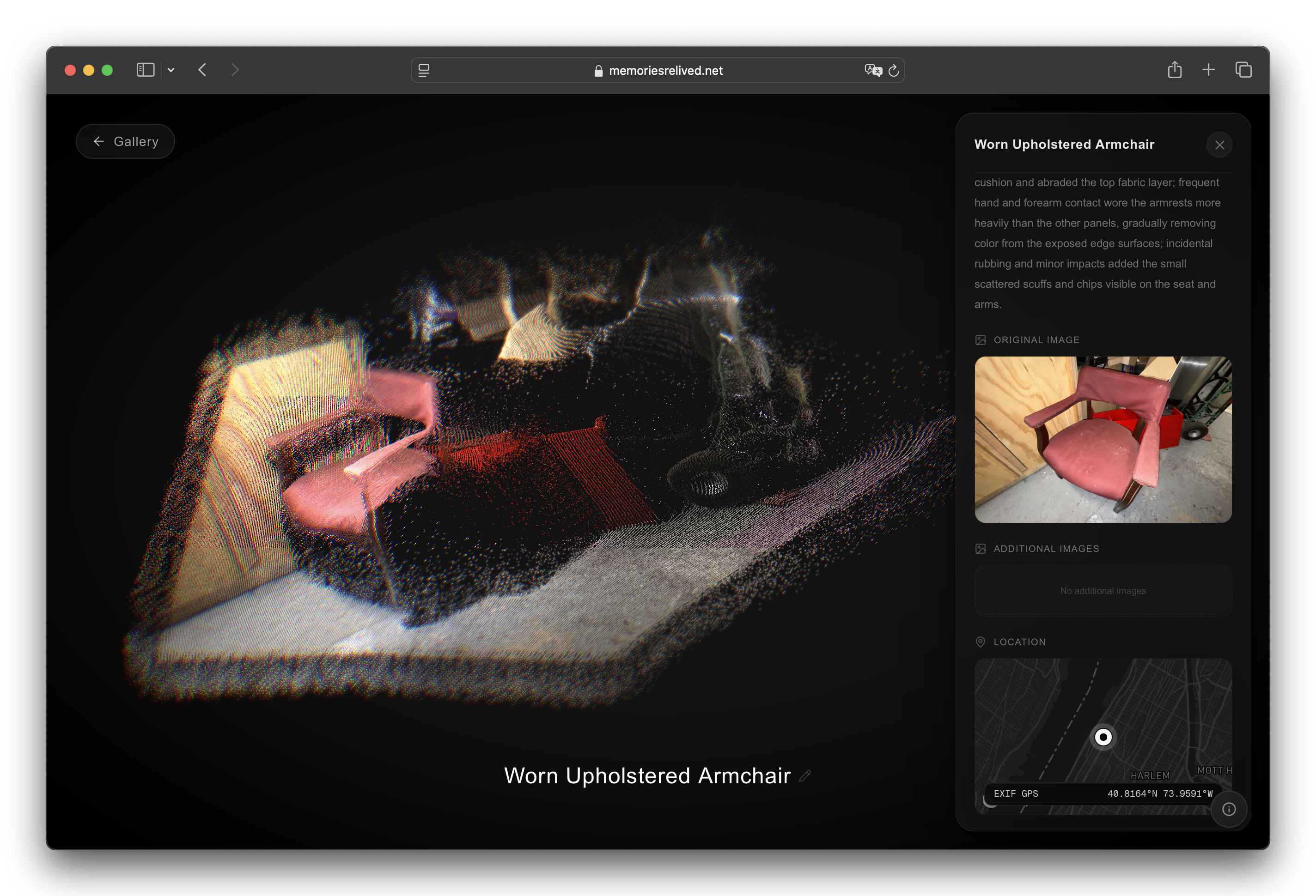
Positioned between archive, interface, and installation, Memories Relived asks how minor material residues might become a democratic form of memory infrastructure. Here, ordinary objects become witnesses, and preservation becomes participatory.
The work draws on material anthropology, media theory, and critical studies of computation to understand making, photography, interface, and AI as situated systems rather than neutral tools.[1][2][3][4] It also engages forensic and heritage documentation practices, asking how evidence, surface change, and spatial capture can be opened to everyday participants rather than reserved for institutional preservation alone.[5][6][7] Media archaeology provides a further frame for reading damaged, worn, and obsolete material traces as active carriers of memory.[8]
References
Tim Ingold, Making: Anthropology, Archaeology, Art and Architecture (London: Routledge, 2013), https://www.taylorfrancis.com/books/mono/10.4324/9780203559055/making-tim-ingold. ↩︎
Vilem Flusser, Towards a Philosophy of Photography, trans. Anthony Mathews (London: Reaktion Books, 2000), https://press.uchicago.edu/ucp/books/book/distributed/T/bo3535843.html. ↩︎
Lev Manovich, The Language of New Media (Cambridge, MA: The MIT Press, 2001), https://mitpress.mit.edu/9780262133746/the-language-of-new-media/. ↩︎
Kate Crawford, Atlas of AI: Power, Politics, and the Planetary Costs of Artificial Intelligence (New Haven: Yale University Press, 2021), https://yalebooks.yale.edu/9780300252392/atlas-of-ai/. ↩︎
Forensic Architecture, "Publications," accessed May 11, 2026, https://forensic-architecture.org/publications. ↩︎
Abdul Wahab Hashmi et al., "Surface Characteristics Measurement Using Computer Vision: A Review," Computer Modeling in Engineering & Sciences 135, no. 2 (2023): 917-1005, https://doi.org/10.32604/cmes.2023.021223. ↩︎
Mariella De Fino, Rosella Alessia Galantucci, and Fabio Fatiguso, "Condition Assessment of Heritage Buildings via Photogrammetry: A Scoping Review from the Perspective of Decision Makers," Heritage 6, no. 11 (2023): 7031-7066, https://doi.org/10.3390/heritage6110367. ↩︎
Jussi Parikka, What Is Media Archaeology? (Cambridge: Polity, 2012), https://www.politybooks.com/bookdetail?book_slug=what-is-media-archaeology--9780745650258. ↩︎